WIRRAL'S OFFICIAL ITF TAEKWON-DO SCHOOL
  • Home
  • About
    • Our School & FAQ's
    • Instructors
    • Safeguarding
  • Classes & Prices
    • Prices
    • Class Times & Venues
  • Gallery
  • News & Events
    • News
    • Calendar of Events
    • Blog
  • Competitions
  • Beginners
  • How to join
  • Members Area
  • Contact
  • Hire our Facility

The Taekwon-do Blog

So now you're a Green Belt / Blue Belt

27/10/2019

0 Comments


We, and other TKD schools, lose most students somewhere between green belt and blue belt. Why?

1. It gets harder;
  • breaking gets more difficult e.g. reverse turning kicks
  • you need leg and core strength to do a decent side kick in Won Hyo / Yul Gok / Joong Gun
  • you need to demonstrate power in your patterns and speed/ agility in sparring
This all takes sustained effort, time, and will power.

2. People feel they’re not making progress;
  • it takes longer between gradings
  • you ‘learn’ a new pattern quickly, but still can’t grade
  • it looks like people of lower grades are catching up with you
You are making progress - leg and core strength, flexibility, timing, power, agility, accuracy of targeting in set sparring and free sparring are improving week by week – but it’s subtle.

Lower grades may appear to be catching up but will also get stuck at green / blue stripe / blue belt.

Sometimes they really are catching up with you and may overtake you, (because they’re younger /older, more flexible etc), but so what?

Categories

All
Children
Etiquette
Fear
Fitness
Gaining A Belt
Grading
Humbling Lesson
Power

Stick with it, and one day, seemingly out of the blue, you'll smash that breaking technique, win that Gold, perfect that elusive technique, realise your own power...... and think 'Wow, where did that come from'

0 Comments

Pilates for the Martial Artist

5/8/2019

0 Comments

 
When I injured my knee a few years ago and couldn’t do Taekwon-do or my usual exercise routines properly, I didn’t want to lose strength and fitness whilst waiting for surgery, so I decided to try Pilates.  After the surgery I continued Pilates during my rehab.
 
Once I had regained normal use of my knee, I decided to continue with Pilates anyway, as I found it benefitted me on top of my Taekwon-do training which I had returned to. In particular, isolation of different muscle groups and increased proprioception in certain areas. It wasn’t always easy to find the time, but having that routine of a regular class made me continue.
 
A couple of years down the line and I started to have problems with my other knee and my hip. Having my hip investigated took far too long, 10 months. During this time, I did virtually no Taekwon-do and stopped running altogether, but I managed to continue with Pilates. Luckily my Pilates instructor Amanda Fryer-Harris is very knowledgeable and takes a lot of care in what each of her students can do and how they do it, taking into account any injuries or limitations, she makes adjustments accordingly throughout the class.  
 
Pilates is very varied and there are some movements which I must avoid, but there are plenty that I can do, and I continue to feel the benefit. My Taekwon-do is limited mostly to teaching now, but I’m so glad I decided to take up Pilates when I did, in fact I wish I’d found it sooner. In martial arts we tend to use  ‘power’ muscles sometimes at the expense of the more subtle ones, for this reason Pilates complements martial arts well and I would recommend it to other martial artists of any level.

Categories

All
Children
Etiquette
Fear
Fitness
Gaining A Belt
Grading
Humbling Lesson
Power

0 Comments

Be like Ben

19/2/2019

0 Comments

 
A long time ago I learned a humbling lesson from an 11 year old boy.  

I had been asked out of the blue if I could do a session in Taekwon-do / self-defence  at a school for children with a variety of disabilities. It was a last-minute thing as someone else had dropped out. I asked the person who contacted me what the abilities of the kids were, so that I could plan the session. She told me that some were in wheel chairs but that they could all use their upper bodies and arms, so I planned accordingly. However, this didn’t quite turn out to be the case.  

I can still see Ben’s face to this day.  I had planned activities such a hitting focus pads, and kicking  too for those who could use their legs, but Ben could not move his arms or legs, nor turn his head, he couldn’t move anything at all except two  fingers on one hand, which he used to control his electric wheelchair.

When I saw Ben I felt inadequate, unprepared. How could I involve him? Ben could not kick or hit or even hold a pad. How awful he was going to feel watching the other kids enjoying themselves when he couldn’t join in.

As it turned out I could not have been more wrong. Ben was one of the most active participants of all.  His big wide eyes watched everything, he had a huge grin on his face the whole time and he kept shouting encouragement to the other kids, “go on, hit it harder!” “Yes that’s it! That was a good one!” “now you hit it Jamie, it’s your turn!” and so on. He was just so excited as he watched the others and shouted his encouragement. It was as though he was doing it himself. How much empathy that kid must have developed living his life as a watcher rather than a doer.

As he couldn’t turn his head, he would use his fingers to control the wheel chair and turn it to watch what was going on. After a while I realised that I might be able to involve him a little more and suggested he swing his chair into the big kick shield. He looked shocked at first when I suggested it, even showed a little trepidation at being asked to join in, but eventually he had a go. It was a success, he found he could swing the chair at the shield as though he was hitting it, and he laughed and laughed, he loved it. But no more so than he loved watching the others, and he was happy to stop after a short time, and watch and encourage the others again.

As a martial artist, so much pleasure in my life has been in doing, aiming to do, pursuing physical goals, but it gets harder and eventually there will come a time where I can no longer do, and that’s where the lesson from Ben comes in; you can derive the greatest of pleasure from watching and encouraging others.

Categories

All
Children
Etiquette
Fear
Fitness
Gaining A Belt
Grading
Humbling Lesson
Power

0 Comments

Why are People too Afraid to try a Martial Art?

5/5/2018

2 Comments

 
Newcomers to our Taekwon-do school come in all shapes, sizes and ages. We have a minimum age of 6 (you can read  why  here), and the oldest starters we’ve had over the years have been in their 50’s, but of course we don’t have a maximum age so there’s no reason why someone older couldn’t start. We’ve also had beginners of every age in between, teens, 20 somethings, 30 somethings, 40 somethings. Sometimes adult beginners come along with their kids, but I want to focus this article on those who don't.

Some adults who come new to us have done TKD or another martial art before, often many years ago, and have decided to pick it up again, they are usually quick to tell me they’ve forgotten everything and want to be considered beginners, however it usually becomes apparent that their muscles have not forgotten as much as they think.

Other adult beginners are brand new to martial arts. They have decided to learn something new, to exercise their minds as well as their bodies, to keep fit, to meet like-minded people. Perhaps it’s something they always wanted to do when they were younger but never had the chance.

Here are some of the questions I get asked by adults making enquiries, along with some answers:

Are there any other beginners? There may or may not be at any given time, but there will be a range of people of different grades, and, within weeks, someone else will join after you and you will no longer be a beginner, you may soon find yourself showing others what to do.

I have never done anything  like this before will I still be OK to join?      We are a school, with teachers, it’s what we do. If everyone could already do it, we would have no purpose.

Do I need to be fit?  People usually start an activity to get fit, so they wouldn’t be expected to be fit already, we take you however you come.

Is there a beginner’s class? Very, very occasionally, but don’t wait for one to come up, just join, after a few lessons you won’t be a beginner anymore.

I sense their nervousness. They fear that everyone else will know what they are doing while they will be left floundering. Some people fear this so much, that having taken the first step of getting in touch and arranging to come, they fail to make it to the second step and don’t show up on the day.

Then there are the unspoken questions;
No, you won’t be thrown into sparring on your first lesson, nor even for the first few lessons. No one will kick or punch you and you won’t be expected to hit anything other than a focus pad or punch bag. When you do start to spar it will be slow, controlled, without contact, until you build up your skills and confidence when you will find yourself wanting to do more.

If, as a beginner, you are put with a partner to work on something, that partner will either be another complete beginner, or a higher grade student whose aim is to help you. A training partner is not an opponant. Everyone is friendly, everyone is helpful.

The beauty of martial arts for the adult beginner is that you don’t have to have done anything before, it doesn’t matter how unfit you are, how uncoordinated you are, or how (your choice of negative quality here) you are. Unlike team sports where your lack of skills may let your team down, Taekwon-do doesn't work like that, each person will make progress at their own pace, and other members of all levels are only too willing to help. We were all beginners once, some as kids, but others as adults of all ages. We are a team, but in a very different sense.

So, having dispelled the idea that you will be floundering helplessly amongst experts, the next myth to dispel is that there won’t be anyone ‘like me’ there, whatever ‘like-me’ is. We have people from all walks of life, all levels of education, genders, cultures, and social class  -if you subscribe to such constructs. The good thing is though, it doesn’t matter. We put our doboks on and we are all just martial artist.

And so, back to my motivation for writing this article; as I said, some adults contact me, arrange a trial and then don’t turn up. What I didn’t say though, may surprise you unless you too are a martial arts instructor, is that MOST of them don’t turn up. Maybe only one in six actually turn up.

They want to do it. They have selected a school. They are welcomed when they enquire. They arrange to come. They sound keen, committed. They plan on coming. They don’t come. Why not?

Categories

All
Children
Etiquette
Fear
Fitness
Gaining A Belt
Grading
Humbling Lesson
Power

2 Comments

Girl Power

2/1/2018

1 Comment


Categories

All
Children
Etiquette
Fear
Fitness
Gaining A Belt
Grading
Humbling Lesson
Power

1 Comment

What is the best age for a child to start martial arts?

5/5/2017

12 Comments

 
Picture

As an instructor I regularly get phone calls from parents of children as young as three enquiring about Taekwon-Do classes for their child. My own feeling as a parent, teacher and instructor, has always been that this is far too young. However parents seem reluctant to believe me and I know that no sooner have I hung up the 'phone than they will call another Taekwon-Do school to ask the same question until they find someone who will accept them. I recently witnessed a martial arts demonstration in which a child aged around 3 or 4 took part with a dummy in his mouth! I teach children from the age of 6, or 5 if their parents do it too. Still, I wanted some evidence to back up my gut feeling so I decided to do some research.  


Bruce Lee, probably the best known and most highly acclaimed martial artist ever was 13 years old when he began his training[1] as was female martial arts film legend Cynthia Rothrock who holds Black Belts in Tang Soo Do, Taekwon Do, Eagle Claw, Wu Shu, and Northern Shaolin[2]. Jean Claude Van Damme was around 11 or 12,[3]  whilst film legend Chuck Norris was older at 18[4].  General Choi Hong-Hi, founder of Taekwon-Do, was
around the age of 20 when he had his first encounter with martial arts [5] and Michelle Yeoh of Crouching Tiger and James Bond Tomorrow Never Dies fame, didn't start martial arts training until 22, however she had been doing ballet since the age of 4.[6]
 
From this it would seem that attaining a high level of success in martial arts is not dependant on a very early start, all these people being above 11 years old. However some other martial arts greats did begin a little younger. Jet Li of The Enforcer and Romeo Must Die fame, was aged 8 when he began [7]  Jackie Chan was 7 [8],  Grandmaster Rhee Ki Ha was around 7 or 8 when he began judo, (his first introduction to martial arts)[9] and Steven Seagal was around 6 or 7 [10]    
 
The starting ages of these martial arts greats ranges from 6 or 7 to 22, but there is little evidence to be found of success by children starting below the age of 6. The lack of evidence could be because this is indeed too young, but there may be other reasons. It may be that in the 1960s and 70s martial arts training was not so widely available for young children and not as popular with parents as a chosen activity for their child, certainly in western cultures.

What about the Shaolin monks? Research suggests that some Chinese children begin their Kung Fu training between the ages of  4 and 10 years[11]  although the senior successful monks my
research turned up began when they were around 8 to 11 years old [12]  making the evidence inconclusive.

Next I carried out a survey amongst Taekwon-Do Instructors. Thirty seven instructors took part, ranging from 1st to 8th Dan. These included seven Masters/ Senior Masters, all but one of whom began Taekwon-Do at 13 or over, the one exception being Master Andrew Rhee, son of Grandmaster Rhee who might be considered an exception due to his parentage, he began at the age of 7. Twenty out of  twenty two 4th to 6th Dans were 13 years old or over, while two were between 10 and 12. Of eight 1st to 3rd Dans, all but one were 13 or older, whilst one was aged just 6. In summary 35 out of 37 instructors began aged 10 or older, one began aged 6 and one 7. Six had tried another martial art at a younger age though none at younger than 7. Still no evidence for the under 6s.

However, the survey did not asked the current age of instructors, so the same could be true as with the 'famous' martial artists, was there less popularity or availability of classes for young children when they were below 6 than there is now?

To investigate further we need to skip to the next generation, the students of these instructors. Of thirty seven instructors, nine had taught children of 3 or 3½  but none had had a 3 year old starter reach black belt. Some of these children may still be training but only one instructor had managed to get a 3 year old starter to at least green belt. Fifteen instructors had taught 4 or 4½ year olds, three of whom had had a child go on to achieve a black belt (in no cases were children the offspring of the instructors). Are these 4 year olds exceptional? With low numbers in the survey it is difficult to know for sure.
More interestingly though, I discovered that of 30 instructors who had taught 5 year olds, nine of them (almost a third) had had children go on to achieve black belt. So perhaps 5 is a good age to start in order to be successful.


However, at this point, a further question needs to be asked. Should we consider gaining a black belt as the measure of success? In the survey I suggested you might consider reaching green belt as a measure of success and asked if instructors had other ways to measure it. Some suggestions were that a child's self esteem is raised, or that they enjoy it for at least three months or other named periods of time.
A 3,4 or 5 year old child has really no concept of future success, they just know what they want now. The ambition probably comes from the parent, but what does the parent want for their child? To enjoy an activity for a few months? To improve their coordination and confidence?  To become a black belt ? To begin an activity for a lifetime? What does the instructor want? What would the child looking back as an adult have wanted for themselves?

One instructor surveyed, pointed out that it was the teenage years when students were most likely to give up, often after having achieved back belt. Is this as a result of starting too early? Could success be measured by a child continuing past the teen years and into adulthood? I personally like this definition of success. Looking back at the evidence, the famous names in martial arts had all begun above the age of 6, yet the evidence from the instructors' survey clearly shows that 5 is a good age to begin in order to progress to black belt. Could early success lead to peaking too early and not continuing the activity for life? Could it be that a slightly later start, above 6 or 7 would give a child a better chance of continuing into adulthood?

The opinions of instructors as to the optimum starting age in order to avoid drop out were mixed, with over a third saying that
they didn't think age was relevant, the other two thirds gave ages between 6 and 11+, with most favouring ages 10 or 11+. None suggested 3,4 or 5. A majority of instructors felt that the involvement of parents or older siblings was an important factor in a younger child's ability to continue and succeed. The length of lessons, structure and activities of the class and qualities of the instructor were also cited as relevant factors.

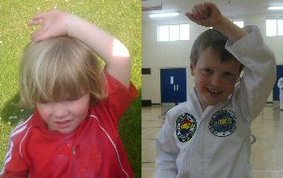
In determining optimum starting age, physiological aspects must also be considered. For example, a child's head is proportionally large and their arms and legs short compared to an adult, thus for example, making the formation of a correct rising block almost impossible, (see photographs - the child on the left is 3, the one on the right is 6). As the child grows, changes in body proportions affect how techniques are performed. For example, changes in the relative size of the head in childhood affects the balance of the body during movement. These factors can slow down the progress of the younger child and although they catch up eventually, they may become bored in the process and give up. A contemporary starting a year or two later would achieve the same standard much more quickly without time for boredom to set in.

By the age of 3, the average child can jump off a step and stand very briefly on one leg, so they could take part in some aspects of a TKD class. However, emotionally at this age children are often clingy, showing fear of separation from parents, and they may show anger or violent outbursts, which would clearly be a problem. By the age of 4 children can usually play cooperatively with other children. Between 4 and 5, they can skip and jump and by 5 they can show responsibility and guilt and feel pride in accomplishments.[13] This sounds more like the level of development needed for a martial arts class, and although the exact age depends on the individual child, instructors may find such milestones a useful guide when setting a minimum age.

When deciding on the starting age, you need to establish what
the aim is, which brings me back to my two favoured measures of success. Firstly, achieving a black belt; none of the instructors surveyed have succeeded in taking a 3 year old starter through to black belt and I can find no martial arts 'greats' who started that young. This leads me to conclude that 3 is too young. I would suspect that if someone is reading this and thinking 'I know someone who started at 3 and got a black belt' that one of two things applies, either the child is the offspring of the instructor (which may put a different slant on things) or the 'black belt' is not from an association with proper standards. Some success was shown with 4 year olds although I believe more evidence is needed. A significant amount of success in reaching black belt was shown with 5 year olds, (similar to that of 6 and 7 year olds).

Regarding my second measure of success, staying into adulthood, it seems that a later start gives a better chance. Evidence gleaned about famous martial artists and current Masters and instructors,  indicates that starting at 6 or above gives a better chance of continuing into adulthood than a younger start, but starting at 10 or above gives a better chance still.

Some parents like to think their child is the exception, and believe that they will not only continue as long as the parent would like them to, but also be much better for having started earlier. In fact if they did succeed after starting at 3 or 4, evidence shows that they would not be any better than if they had started at 7 or 8. The evidence also points to the increased likelihood of
them giving up.

The survey was limited, and didn't take into account numbers of students that individual instructors had taught or succeeded with, or details of those students who had continued as adults. There is a lot more research that could be done in this area. However, I believe there is enough evidence to answer the original question; What is the best age for a child to start a martial art?

For short term benefits such as improved confidence and co-ordination, anything from 4 up. If you want the child to eventually get a black belt, start them from 5. If you want them to get black belt and continue the activity successfully into adulthood, 6 at the youngest, but wait a little longer to improve the odds i.e. between 7 and 10.


References
[1] http://www.bruceleefoundation.org/index.cfm?pid=10378 accessed 23/04/10
[2] http://www.cynthiarothrock.org/biography.html  accessed 23/04/10
[3] http://www.completemartialarts.com/whoswho/actionstars/vandamme.htm  accessed 23/04/10
[4] http://www.completemartialarts.com/whoswho/halloffame/chucknorris.htm  accessed 23/04/10
[5] Choi Hong-Hi, Taekwon-Do and I, The Memoirs of Choi Hong-Hi, the founder of Taekwon-Do, vol 1. ITF (n.d.)
[6] (http://www.michelleyeoh.info/Bio/bio.html accessed 23/04/10
[7]  http://www.jet-li.com/biography/  accessed 24/04/10
[8] http://jackiechan.com/biography accessed 24/04/10
[9] http://www.rita-itf.org/student-gmrhee.htm
[10] http://www.completemartialarts.com/whoswho/halloffame/chucknorris.htm accessed 24/04/10
[11] http://www.shaolin-wushu.de/en/main_fr.htm?training.htm accessed 24/04/10
[12] http://www.chinashaolins.com/ accessed 24/04/10
[13] http://www.childdevelopment.co.uk/ accessed 29/04/10

If you enjoyed the article please think about donating to our community club!


Categories

All
Children
Etiquette
Fear
Fitness
Gaining A Belt
Grading
Humbling Lesson
Power

12 Comments

A belt won't save you

25/3/2016

0 Comments

 
If all you want is a Black belt for yourself or your child, then go and buy one, get it all nicely embroidered with your name and any rank you like for about 25 quid. But beware, a belt will not save you, it will not protect you, it will not win a competition for you. Only correct instruction, dedicated practice and effective training will enable you to develop the skills you need to do this.

An unearned belt will make you look a fool, will make your instructor look a fool and will make you vulnerable.

The instructor who promotes a student before they are ready, potentially harms that student. An unearned black belt can give a student, children & vulnerable adults in particular, a false sense of security in their own ability. It could put a child in a vulnerable position with bullies who, may try to push them to demonstrate what they can do, or provoke them into a fight. Then when the child clearly can't 'do', at best they lose face, get laughed at, and their self esteem takes a bashing, at worst a serious injury could result.

If a student enters a competition wearing a belt that is too high for their ability, they will be totally outclassed, made to look foolish, or get injured. Their instructor will also look foolish, and people will question his or her integrity and ability.

Better to remain forever as an OK green belt than be laughed at as a joke of a 'Black belt'. Of course it's better not to stop progressing but to persevere. So what if you take twice as long as someone else to get to black belt, or if you never get there at all. The point is to enjoy your training and always try to improve.

As instructors we owe it to ourselves, our fellow instructors, fellow practitioners of our art, but most of all to our students, not to grade them too soon.

Students / parents, is it really just a belt that you want? Think again:


  •   Enrol; in a reputable, certified school, part of an established association, one with external examiners

  •   Focus; on what you are learning and the enjoyment you get from training, not on what colour belt you are wearing

  •   Parents;, do not push your children to grade! If you really must push, push them to perfect techniques and persevere with training

  • The belt should not lead, but follow.

Categories

All
Children
Etiquette
Fear
Fitness
Gaining A Belt
Grading
Humbling Lesson
Power

0 Comments

Taekwon-do Etiquette

6/8/2015

1 Comment

 
Ye Jol / Etiquette – (If in doubt, bow!)
 
What is Etiquette?
The subject of etiquette has concerned philosophers and  writers across civilisations for thousands of years. The ancient Egyptians, Greeks and Romans, all developed rules for social conduct.
 
Etiquette involves a series of customs that govern accepted behaviour in particular social groups or social situations. Some
forms of etiquette may have very ancient origins whilst newer social situations also require etiquette and so it evolves in response, for example internet forum etiquette. Etiquette varies from culture to culture but every society throughout the world has it.
 
Sportsmanship may be considered a particular type of etiquette. Appropriate, polite and fair behaviour while participating in a sport, playing by the rules, respecting ones opponent and being gracious in defeat.
 
Why bother?
Etiquette allows social interactions to run smoothly and help us to know what behaviour to expect from others, it is an important part of our non-verbal communication, sending unspoken messages to those around us.
 
Children need to learn how to be courteous, and respectful to others so they can have smooth social interactions. In order for these skills to become part of them, they need to be put into practice regularly.
 
Good sportsmanship, not only allows participants in a sporting event or competition to expect fair treatment, but gives a sense of fellowship with other competitors.
 
Martial arts etiquette is usually based around that of the cultures from which the arts have developed. For those of us not raised in the oriental culture, martial arts etiquette may seem a little alien
at first, whereas those whose culture more closely resembles that of their art will find it less so.  However as practitioners of the same art, we all need to follow the same code of conduct.
 
Taekwon-do etiquette
Let's start from the beginning; the student entering the dojang bows to the instructor or senior grade in the room, if there is no senior they should bow towards the association flag if there is one. Why? This demonstrates respect to the instructor or the association. One might argue that the association is not a person and does not know it is being bowed to so why bother? Well if there is anyone else in the room you are demonstrating to them your respect for your association. If you are entirely alone as you enter, then you can please yourself whether to bow or not, but it is often still good practice, as following that ritual it puts you in the right frame of mind to begin your training.
 
If the instructor enters the dojang after you, stop what you are doing and bow towards him or her. If you have seen the instructor and others have not, you should call the class to attention and have them all bow.
 
Bow when addressing or being addressed by, your instructor or senior. When approaching the instructor to speak you should bow first, and when walking away, bow, then take 3 steps backwards before turning. Bow again when leaving the dojang.
 
How to bow; in Taekwon-Do we bow in charyot stance, heels together, feet at 45 degrees, hands closed into fists with elbows slightly bent. The bow should be about 15 degrees and eye contact is maintained. The junior rank should begin to bow first and should not come up until the senior has done so. 
 
Some Taekwon-do groups bow in Japanese style with hands flat or even slapped, against their thighs. I was in attendance at a seminar conducted by General Choi in 1996 when someone bowed to him this way. General Choi gave quite a stern lecture saying “no, this is not how we bow, why do you bow like this? This is not Korean bow, this is not Taekwon-do bow” and he mimicked the thigh slapping bow before demonstrating as I have described above.
 
Addressing instructors and seniors; black belts of higher rank than you should always be addressed as Sir or Miss in the dojang. Outside of the dojang, they may invite you to call them by their first name or they may not. If they do however, this does not mean that you should refer to them by their first name in the dojang.
 
NB. An official at a competition should be treated as your senior when you are a competitor, even if they are of lower rank.
 
Sitting; during a lesson or seminar if you are asked to sit, students should sit with the soles of their feet together or with legs crossed, or kneel, they should not have their feet extended in front of them as in oriental culture showing the soles of your feet is rude.
 
Straightening doboks; if your dobok needs straightening during class, turn briefly away from the instructor to adjust it, but do not turn your back on the instructor, turn to the side.

 
Shaking hands; the left hand supports the right elbow, as a sign of respect to one’s senior. The lower rank should also bow while shaking hands. The lower rank should not offer their hand first but should wait until the senior does so, and they should not have too firm a grip.
Opening doors; the junior grade should hold the door open for the senior and allow them to enter first.
Giving or receiving; when giving or receiving something from your senior two hands should be used, as with the handshake, the left supports the arm of the right, or two hands hold the object. The use of two hands either way shows that you are giving your full attention. You should also bow.
 
Dining; at lunch during a competition break for example, if a more senior grade than any currently there comes in the room, everyone should stand. If a more senior grade than yourself enters you do not have to stand unless they are then the most senior in the room. Lower grades should wait for the most senior rank to begin eating first even, if the senior tells you to go ahead and start.
I have noticed that one or two of the parents of my child students observe aspects of our etiquette, such as bowing in and out of the room, I find this really nice, as it not only sets an example to their children, but shows that they feel part of our Taekwon-do family
 
Adherence to traditions and demonstrations of respect are what sets martial artists apart. It is for the juniors in rank to ensure that their seniors are suitably respected with use of correct etiquette, it should not be for the seniors to remind them or to have to ask for adherence to etiquette.
 
When you choose to take part in Taekwon-do, you take it all on board, not just some parts of it. Etiquette is a big part of Taekwon-do so let's embrace it.


Categories

All
Children
Etiquette
Fear
Fitness
Gaining A Belt
Grading
Humbling Lesson
Power

1 Comment

When will my child be ready to grade?

11/2/2015

0 Comments

 
Sometimes parents are anxious about the rate of progress their child is making. Every child will progress at their own pace due to differences in:
  • Age
  • Innate ability (have they got the 'sporty gene')
  • Concentration span
  • How often they train
  • How interested they are in progressing
  • Whether or not they practice at home
  • If they have older siblings / parents who do it
  • If they are learning other sports or activities at the same time.
  • General motivation
  • Learning disability
  • Physical disability

At Wirral UKTA, when a grading comes up, some people will be ready, others won't. Usually only a handful at a time grade. For this reason any child not ready to grade need not feel left out or different from the others as they will be in the majority NOT
grading.

A child who is slower to progress may notice that others who started after them are beginning to overtake them. To avoid the child losing self-confidence if this happens, parents can explain it to them using some of the reasons above, i.e “He's learned it faster as he's older than you” or “She has a older brother who helps her at home” “They come more often than you” etc. Kids are quite happy with these explanations.

If a child is slow progressing, its important for the parent not to pressure them, its best that parents don't ask the instructor if their child is ready, in front of the child. Better to ask when the child is not around or by phone or email. Parents could also ask how they can help their children at home and instructors are only too willing to explain points to help them with, as long as the child is willing.

If a sensitive child is making slow progress, it is important that parents don't try to put their child in for a grading against the instructors advice. Failure is far worse than just not being put in for it. The main thing is that the child enjoys taekwon-do.

To put things in perspective, I had one child who took a year to get to yellow tag, and another student who spent 7 years on one belt colour. They both enjoyed it and kept coming and they both moved up to the following grades a lot faster.

Don't feel as though belt colour is everything, its not. Children can be given encouragement and praise for improvements made along the way, such as mastering a particular kick or improving their balance.

Of course every parent knows their own child best, but in my experience as a teacher and instructor for many years, and as a parent myself, when parents are laid back about it, kids take it all in their stride but when parents become hung up and anxious about gradings, kids do the same.


Categories

All
Children
Etiquette
Fear
Fitness
Gaining A Belt
Grading
Humbling Lesson
Power

0 Comments

9 Ways to encourage your child to stick at Taekwon-do and becomevery good at it

5/5/2012

0 Comments

 
OK 10 would’ve sounded better but I could only think of 9!

1. join with them
2. stay and watch the lessons rather than drop them off
3. bring them at least twice a week
4. take them to additional events such as competitions, seminars & demonstrations, whenever possible
5. watch them perform their patterns at home
6. help them learn their theory
7. talk to them about their progress
8. ask the instructor if there’s anything they need to work on which could be practised at home
9. speak to the instructor straight away if they have any worries

Most of the above apply from tots right up to older teenagers.


Categories

All
Children
Etiquette
Fear
Fitness
Gaining A Belt
Grading
Humbling Lesson
Power

0 Comments
<<Previous
Proudly powered by Weebly
  • Home
  • About
    • Our School & FAQ's
    • Instructors
    • Safeguarding
  • Classes & Prices
    • Prices
    • Class Times & Venues
  • Gallery
  • News & Events
    • News
    • Calendar of Events
    • Blog
  • Competitions
  • Beginners
  • How to join
  • Members Area
  • Contact
  • Hire our Facility